

Copper patina · Copper roof
Roof surface
Copper roof
The roof is the surface on which copper shows its best known face. And the surface where design decisions matter most.
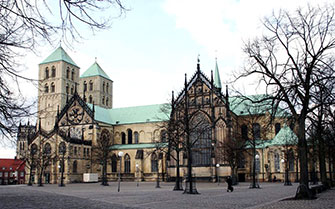
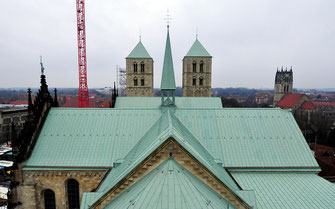
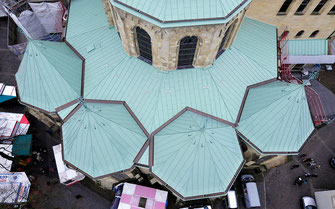
St Paulus Cathedral, Münster
Around 16,000 square metres
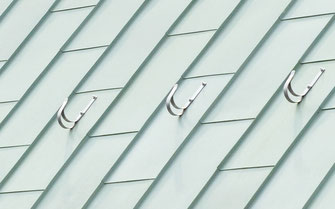
The entire roof surface was patinated in the workshop before it went onto the building. On a surface of that size every unevenness shows, which is why the patina forms with us and not on the roof.
For design
What matters on a copper roof
Sheet thicknessFor copper strip at least 0.6 mm to EN 1172 is chosen. For roof and wall surfaces in view with particular visual demands, 0.7 mm is recommended because the surface then reads smoother.
Weight per m²0.6 mm 5.3 kg · 0.7 mm 6.2 kg · 0.8 mm 7.1 kg · 1.0 mm 8.9 kg
Bay lengthUnder the German trade rules and the VOB at most 10 m, so temperature movement is safely absorbed. Beyond that, expansion joints are needed.
Separating layerNot required to protect the copper. Even with moisture present, copper is unaffected by substances in timber and by salty or oily impregnations of the boarding.
Roof to wall junctionProvide a drip edge. Without it, water runs from the pitched onto the vertical surface and carries the colour development along.
Run-off waterDo not route freely over pale materials such as natural stone, fair-faced concrete or render. Controlled water routing with drip edges and gutters settles the matter.
Other metalsCopper is nobler than aluminium, zinc and galvanised steel. In contact with moisture present the less noble metal is attacked. Substructure and fixings in stainless steel, or separating layers.
Material and execution data to EN 1172 and the German Copper Institute information sheet i.30. The details in the quotation of ZinCuTec GmbH are binding for your project.